Tapperhet
Cooking

Building a bold, character-driven cooking brand for men — from positioning strategy to full visual system. Here is how a cooking app built a subculture.

Tapperhet Cooking logo — app branding by Noir Branding Studio

Objective

Differentiate in a saturated market by establishing a strong, ownable subculture identity.

Result

25% MoM growth and 3× higher average ticket price.

Approach

"Bravery Cooking" concept—a bold, disciplined aesthetic targeting men who cook seriously.

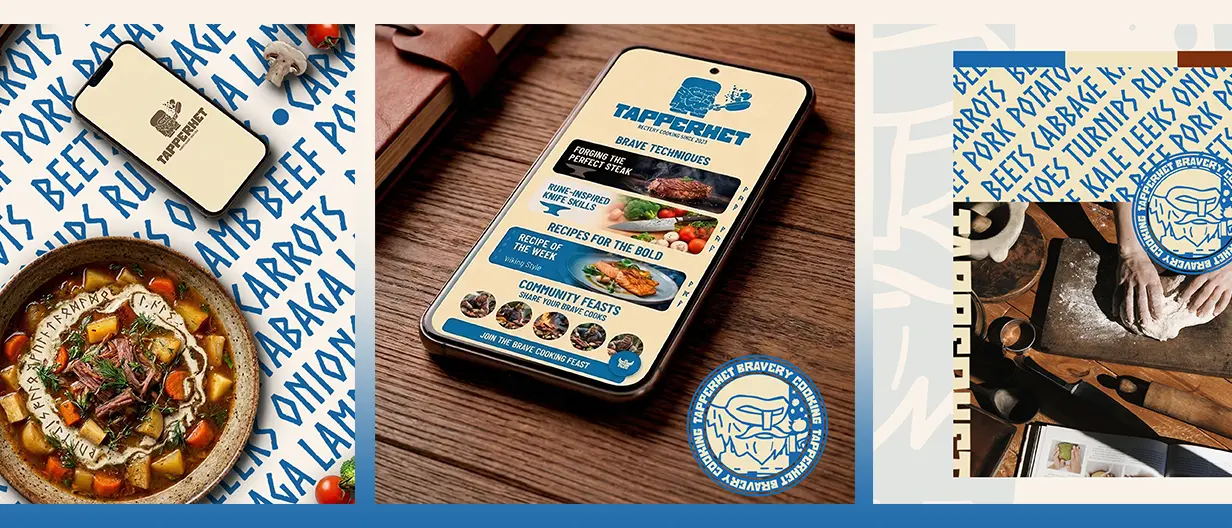
Tapperhet Cooking brand lifestyle photography
Tapperhet Viking Chef Mascot illustration

Build a Subculture.

We positioned Tapperhet around a single powerful idea: Bravery Cooking. Cooking not as a chore, but as an act of discipline and identity. Every design decision—from the Viking Chef mascot to the bold typography—reinforces this specific subculture.

Strategic
Positioning

The core philosophy "Bravery Cooking" drove every design decision. Not as a tagline — as a brief. It shaped the character illustration, the high-contrast palette, the typography pairings, and the irreverent, no-nonsense tone of voice.

  • Mascot Identity: The Viking Chef became a recognizable symbol in under 90 days, creating a unified badge of honor for users.

  • Market Edge: Premium positioning that commanded a 3× higher ticket price than comparable soft, pastel-colored cooking apps.

  • Earned Aesthetic: A color palette and typographic system combining Playfair Display's warmth with Inter's precise discipline.

The Bravery Palette

Optimized for high-contrast visibility and a disciplined, masculine aesthetic.

The real problems we solve

Your app is drowning in a sea of generic competitors.

Most tech startups spend heavily on user acquisition, only to see churn rates spike because the app looks and feels like everything else. If your app lacks visual distinction, users treat it as a disposable commodity. A weak brand forces you to compete purely on features and pricing.

The apps that dominate their niche don't appeal to everyone—they build cult-like loyalty among a specific few. Investing in a distinct, unapologetic brand infrastructure makes acquisition cheaper and dramatically improves user retention.

Problem 01

How do I make my app stand out in a saturated market?

The fastest path to standing out is to stop appealing to the masses. The market is saturated with safe, soft aesthetics. Investing in a distinct, polarizing visual identity creates a subculture that resonates deeply with your core demographic, consistently outperforming generic ad campaigns.

Problem 02

Why am I not attracting premium users?

High-value users judge an app's credibility visually before they download it. If your brand looks like a template—standard UI kits, stock photography, uninspired logos—premium buyers self-select out. Professional, tailored branding signals authority and justifies premium pricing.

Problem 03

How do I differentiate without building new features?

Most founders try to code their way out of a differentiation problem. However, brand differentiation works visually, verbally, and strategically. By targeting a specific persona with a unique aesthetic language, you can completely eliminate direct competitors without changing a line of backend code.

Problem 04

How do I increase app user retention?

Retention goes beyond push notifications; it's an emotional contract. Users stay with apps that align with their identity. Brand design that builds a sense of community—like Tapperhet's 'Brave Cooks'—turns casual users into loyal advocates who renew subscriptions without hesitation.

Problem 05

How do I grow my startup without a big budget?

The highest-leverage investment for an early-stage app is brand clarity. Done right, a strong identity enables organic word-of-mouth growth and gives users a reason to share your app. It creates a compounding effect, allowing you to scale without relying exclusively on paid acquisition.

Problem 06

Why does my marketing not convert?

Poor conversion is almost never a targeting problem — it's a trust problem. If your App Store screenshots, social media, and website don't create a confident, cohesive impression, users will keep bouncing. Brand consistency is the foundation upon which all successful marketing is built.

Why brand design
drives revenue

There's a persistent myth that branding is a cost — something you do when you can afford it. The data tells the opposite story. Brand consistency alone increases revenue by up to 23% (Forbes, Lucidpress) because it reduces cognitive friction at every stage of the buying journey.

When an app looks and sounds like it knows exactly who it serves, users don't need convincing. The brand does the selling. Every touchpoint reinforces the same emotional promise, compressing the decision cycle and driving up lifetime customer value.

The businesses that invest in brand infrastructure early spend less per acquisition, retain clients longer, and exit at higher multiples. Brand isn't an aesthetic choice. It's a business asset.

25%

Month-over-month growth driven by highly qualified leads who self-identified with the brand persona.

Higher average ticket due to premium positioning compared to standard market rates.

1

Ownable market position. Zero direct visual competitors allowed them to dominate the niche.

< 90

Days required for the mascot to become a recognizable, community-driven symbol.

Questions we get
every week

Straight answers to the real doubts business owners have before investing in brand.

Most clients see measurable shifts in conversion rates and perceived value within 60–90 days of launch. The change in how existing clients describe your business — word of mouth, organic referrals, the quality of inbound inquiries — typically begins within the first month. A stronger brand gives your audience the language to describe you clearly, which is what spreads.

A logo is a mark. A brand is a complete system: the visual identity, the messaging architecture, the emotional positioning, the customer experience, and the consistent promise you make across every touchpoint. A logo without a brand system is a decoration. A brand system makes every interaction — social posts, proposals, packaging, customer service — feel like the same trustworthy entity.

The better question is: can a startup afford not to? Every month you operate with a weak brand is a month of higher acquisition costs, lower retention, and a user base built on features rather than loyalty. A professional brand identity typically pays for itself through improved user lifetime value (LTV) and lower CAC long before Series A.

Three clear signals you've outgrown your current brand: you're winning users despite your brand, not because of it; your pricing is constrained by what the brand can justify; or you're attracting a different user than you want to serve. A brand refresh doesn't mean starting over — it means aligning the way you look with the app you've actually become.

Every marketing channel — paid ads, content, email, SEO — sends traffic to your brand. If the brand converts poorly, the channel looks ineffective. Improve the brand and every channel gets cheaper: lower cost-per-click (higher quality score), higher app store conversion rates, and better organic engagement.

How we build
brands that convert

Four phases. No templates. Every decision tied to a specific business outcome.

Phase 01

Strategy

We identify the exact buyer psychology, market positioning gap, and emotional territory your brand needs to own. This is the brief every visual decision answers to.

Phase 02

Identity

Logomark, color system, typography, and visual language built as a coherent system — not a collection of assets. Everything designed to scale and stay consistent.

Phase 03

Application

The identity applied across the touchpoints that matter most for your specific business: website, social, pitch materials, packaging, or product UI.

Phase 04

Launch

You leave with a brand guidelines document, all source files, and the clarity to make every future design decision confidently — with or without us.

Ready to build a brand that brings clients to you?

Tell us about your business. We'll tell you what's holding the brand back — and how to fix it.

Start a Project